Our trip from Bangkok to Kyoto was uneventful and relatively short. Normally short is good, but it was an overnight flight and so more time would have been nice. We arrived exhausted after only a couple hours of fitful sleep. We collected our luggage, exchanged our money and headed for the train station that would take us from the airport to Kyoto. We decided to buy the four day Japan Rail Pass, which was a much better deal than buying individual train tickets, and then started the long journey to our new digs.
The airport express took us from Kansai International Airport to Kyoto in about an hour. From there, we had to change to the metro and then walk about 15 minutes to our furnished apartment. Since we were planning on staying in Kyoto for ten days, we decided to stay at a furnished apartment rather than a hotel or hostel. We thought that would offer us some privacy and a chance to save some money by cooking some of our own meals. We had no trouble finding the place, and the owner was there waiting to show us the space.
It was a traditional Japanese style apartment. There was a small kitchen, a bathroom, and a living room area. The loving area was covered in the traditional tatami matt style, and there were two fold out beds for sleeping on. There was a small coffee table for eating and working, and floor pillows to sit on. It’s a good thing we got used to sitting on the floor so much in India!
Once we had thrown down our backpacks it was time to head out for some food, but first we needed some cash. No problem, the apartment owner assured us that there were ATMs on every corner. Unfortunately in Japan, they use a different ATM network than any other country in the world, and most ATMs do not accept non-Japanese cards. Two hours and seven banks later, we finally had some cash. By then our serious lack of sleep had caught up with us, so we bought some ramen noodles from the local 7-11 and slurped them down before crashing on the floor.
Tuesday, July 14, 2009


Thursday, June 11, 2009
Back in Bangkok
After our excursion in to Laos, it was Back to Bangkok. Our first visit to Thailand’s capital was not quite normal, what with the New Year and the protesting and all, so we were looking forward to getting another look at Bangkok. We decided to try a different part of town, and opted for a hotel in Siam rather than near the backpacker haven of Khosan Road. We had a hard time finding the place (our taxi driver did his best to understand our poor Thai and it took three tries before we ended up at the right hotel), but once we were there, it was a whole different Bangkok.
Siam is the heart of Bangkok’s shopping district, and what a shopping district! I have never seen so many big malls so close together. The major intersection closest to our hotel had a shopping mall on three of the four corners. All were at least 6 stories high and had a huge number of stores, restaurants, and entertainment venues. All of the malls were connected by skywalks and the Bangkok Skytrain (for those malls further down the street) so you never even had to go out onto the street. You could just go straight from one mall to another without ever opening your umbrella even during the rainy season.
This area also houses all the comforts of home, and we used our time here to get all those things we had been missing. Leon ate at Burger King at least three times. We went to the cinema three days in a row, and even went bowling! Leon was patient while I perused the goods at Jimmy Choo, Chanel, Tiffany’s, and Michael Kors (come on it’s been months since I have seen a fashion magazine!).
After a week of comfort we were ready to move on to the next adventure. We were headed to Osaka, Japan and were ready to reimburse ourselves in Asian culture. Konnichiwa Osaka!
Siam is the heart of Bangkok’s shopping district, and what a shopping district! I have never seen so many big malls so close together. The major intersection closest to our hotel had a shopping mall on three of the four corners. All were at least 6 stories high and had a huge number of stores, restaurants, and entertainment venues. All of the malls were connected by skywalks and the Bangkok Skytrain (for those malls further down the street) so you never even had to go out onto the street. You could just go straight from one mall to another without ever opening your umbrella even during the rainy season.
This area also houses all the comforts of home, and we used our time here to get all those things we had been missing. Leon ate at Burger King at least three times. We went to the cinema three days in a row, and even went bowling! Leon was patient while I perused the goods at Jimmy Choo, Chanel, Tiffany’s, and Michael Kors (come on it’s been months since I have seen a fashion magazine!).
After a week of comfort we were ready to move on to the next adventure. We were headed to Osaka, Japan and were ready to reimburse ourselves in Asian culture. Konnichiwa Osaka!
 |
| Bangkok Part 2 |
Thursday, June 4, 2009
Laos
The trip from Thailand to Laos was our first real overland border crossing, and we weren’t really sure what to expect. The book had warned of long lines, red tape, and possible bribes so we were a little nervous as we approached the border. Instead, the whole process was relatively easy. The Mekong River marks the border between the two countries, and two small towns on either side serve as the immigration check points. We arrived in Chiang Khong (the Thai side) by bus, took a taxi to the Thai immigration office where they stamped us out of the country. Then we walked down to the river and took a long boat across the Mekong to Laos. Once on the Laos side, it was two passport photos and $35 for a visa. The whole process took less than an hour.
We found ourselves in Houai Xai for the night, which is literally a one street town. Fortunately we found a nice hotel with a great view of the river, and a local restaurant which offered good food at cheap prices. The next morning, we prepared for our long journey to Luang Prabang. The best way to get there from Houai Xai is via slowboat down the Mekong. The journey takes two full days, with an overnight stop at the halfway point of Pakbeng. The boats don’t stop, and there is no food on board, so we grabbed, a quick breakfast, some sandwiches for later, and headed down to the docks to get a seat on a boat.
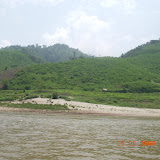
The slowboats are exactly that, slow. For the first few hours you can sit, relax, and soak up the beautiful scenery. When you picture Southeast Asia with the steep mountainous terrain, the rice fields, the farmers and fishermen with their cone shaped straw hats; Laos is what you are picturing. It is amazing, but after a few hours it all starts to look the same, and you realize that you are sitting on a hard wooden bench on an over-crowded boat and you have 4 hours to go before you dock for the night. You try to make the best of it by reading, sipping on some Beer Laos (which is the only thing they sell on the boat) and talking to your neighbors (all tourists even though you’re on the “local” boat).
Day two was even worse than the first. The first day there were two slowboats carrying tourist down the river. On the second morning there was one boat; same number of people. Leon and I snagged seats up front on the floor, which ironically was more comfortable than the wooden bench seats. The second day was also two hours longer than the first, and since there was no excitement to get us through the first few hours like there had been the first day; it was a really long day.
Luang Prabang made up for the crazy boat ride. It was incredibly charming with Buddhist monasteries dispersed among French colonial architecture. The streets were lined with fabulous restaurants serving local, French, and fusion cuisine and shops selling local crafts. The south end of town had a huge night market where local vendors would sell the fabrics and wooden bowls that Laos is famous for. In the morning you could wake up early and watch the hundreds of local monks make their morning alms route. The locals line the streets and sit with steaming hot rice which they offer in handfuls to the monks passing by. The owner of our guesthouse asked me to join her one morning, which I did. The line of monks seemed never-ending and the rice burnt my hands, but the experience was something that I will never forget.
From Luang Prabang it was off to the town of Phosavon to see the mysterious Plain of Jars. Our journey to Phosavon was eventful. First we found seats on the local bus, right across from a nice Irish couple. We were just getting settled in when three men clambered onto the bus with a motorcycle. Where were they going to put a motorcycle on a bus? Apparently, right next to us. They tied the bike in the aisle between our seats, meaning that to get up for any reason, we had to climb over the bike. The drive was mountainous and the roads were curvy. The driver seemed to think that he was Speed Racer, and took over turn with squealing tires. I felt pretty sure for most of the morning that we were either going to fly off the mountain, or that I was going to get sick. All the tire-squealing took its toll, and we ended up with a flat tire and a lunch break. An hour and a half later we were back on the road. The driver, now trying to make up for lost time drove even faster this time, stopping every two hours to get out and inspect the tires to avoid another flat.
Phosavon was an interesting look at the history of Laos. First there was the Plain of Jars, the mysterious stone urns located around the city. No one is completely sure who put them there, or what their purpose was. They have only recently begun to study them. Up until five years ago the area was considered unsafe due to the large number of unexploded ordinance left from the Vietnam War.
The war history of Laos was also interesting. I don’t remember learning a lot about the Vietnam was in school, and I was shocked to discover the impact that the war had and is still having on this developing nation. Laos was actually the most heavily bombed country during the Vietnam War. The Viet Kong used Laos to travel from North to South Vietnam, and America bombed Laos in an effort to stop the flow of traffic. Millions of bombs were dropped on the country and approximately 30% of them remain as unexploded ordinance. Hundreds of children and farmers are still killed and injured every year by bombed that were dropped during a war that ended before I was born.
The Plain of Jars sights have recently been cleared, and as a tourist it is interesting to visit. You have to be careful to stay on the clearly marked paths, because the area off the path hasn’t been cleared. We saw a groundskeeper mowing the lawn around the sight and we both thought, “You couldn’t pay me enough to do that job! Every sweep of the mower could be your last.” It gave us a glimpse of the fear that local farmers face every day plowing their fields. The children actually search out the bombs because the scrap metal is valuable. All through the town you see shells being used as BBQ Grills, fence posts, wind chimes, etc. It is crazy, and sad.
After Phosavon it was time for a lighter mood. We headed south to Vang Vieng, a town that is known for having a backpacker party atmosphere. We rented tubes and floated down the river, enjoying the relaxing vibe. The river bank is lined with bars, and the proprietors throw out ropes to pill you in for a drink or snack. It reminded me a little bit of Beach Weekend in college, and was fun for a day. After a few days of pampering in a nice hotel, and enjoying the beautiful views, it was time to move on. We headed for Vientiane and the Thai border.
We found ourselves in Houai Xai for the night, which is literally a one street town. Fortunately we found a nice hotel with a great view of the river, and a local restaurant which offered good food at cheap prices. The next morning, we prepared for our long journey to Luang Prabang. The best way to get there from Houai Xai is via slowboat down the Mekong. The journey takes two full days, with an overnight stop at the halfway point of Pakbeng. The boats don’t stop, and there is no food on board, so we grabbed, a quick breakfast, some sandwiches for later, and headed down to the docks to get a seat on a boat.
The slowboats are exactly that, slow. For the first few hours you can sit, relax, and soak up the beautiful scenery. When you picture Southeast Asia with the steep mountainous terrain, the rice fields, the farmers and fishermen with their cone shaped straw hats; Laos is what you are picturing. It is amazing, but after a few hours it all starts to look the same, and you realize that you are sitting on a hard wooden bench on an over-crowded boat and you have 4 hours to go before you dock for the night. You try to make the best of it by reading, sipping on some Beer Laos (which is the only thing they sell on the boat) and talking to your neighbors (all tourists even though you’re on the “local” boat).
Day two was even worse than the first. The first day there were two slowboats carrying tourist down the river. On the second morning there was one boat; same number of people. Leon and I snagged seats up front on the floor, which ironically was more comfortable than the wooden bench seats. The second day was also two hours longer than the first, and since there was no excitement to get us through the first few hours like there had been the first day; it was a really long day.
Luang Prabang made up for the crazy boat ride. It was incredibly charming with Buddhist monasteries dispersed among French colonial architecture. The streets were lined with fabulous restaurants serving local, French, and fusion cuisine and shops selling local crafts. The south end of town had a huge night market where local vendors would sell the fabrics and wooden bowls that Laos is famous for. In the morning you could wake up early and watch the hundreds of local monks make their morning alms route. The locals line the streets and sit with steaming hot rice which they offer in handfuls to the monks passing by. The owner of our guesthouse asked me to join her one morning, which I did. The line of monks seemed never-ending and the rice burnt my hands, but the experience was something that I will never forget.
From Luang Prabang it was off to the town of Phosavon to see the mysterious Plain of Jars. Our journey to Phosavon was eventful. First we found seats on the local bus, right across from a nice Irish couple. We were just getting settled in when three men clambered onto the bus with a motorcycle. Where were they going to put a motorcycle on a bus? Apparently, right next to us. They tied the bike in the aisle between our seats, meaning that to get up for any reason, we had to climb over the bike. The drive was mountainous and the roads were curvy. The driver seemed to think that he was Speed Racer, and took over turn with squealing tires. I felt pretty sure for most of the morning that we were either going to fly off the mountain, or that I was going to get sick. All the tire-squealing took its toll, and we ended up with a flat tire and a lunch break. An hour and a half later we were back on the road. The driver, now trying to make up for lost time drove even faster this time, stopping every two hours to get out and inspect the tires to avoid another flat.
Phosavon was an interesting look at the history of Laos. First there was the Plain of Jars, the mysterious stone urns located around the city. No one is completely sure who put them there, or what their purpose was. They have only recently begun to study them. Up until five years ago the area was considered unsafe due to the large number of unexploded ordinance left from the Vietnam War.
The war history of Laos was also interesting. I don’t remember learning a lot about the Vietnam was in school, and I was shocked to discover the impact that the war had and is still having on this developing nation. Laos was actually the most heavily bombed country during the Vietnam War. The Viet Kong used Laos to travel from North to South Vietnam, and America bombed Laos in an effort to stop the flow of traffic. Millions of bombs were dropped on the country and approximately 30% of them remain as unexploded ordinance. Hundreds of children and farmers are still killed and injured every year by bombed that were dropped during a war that ended before I was born.
The Plain of Jars sights have recently been cleared, and as a tourist it is interesting to visit. You have to be careful to stay on the clearly marked paths, because the area off the path hasn’t been cleared. We saw a groundskeeper mowing the lawn around the sight and we both thought, “You couldn’t pay me enough to do that job! Every sweep of the mower could be your last.” It gave us a glimpse of the fear that local farmers face every day plowing their fields. The children actually search out the bombs because the scrap metal is valuable. All through the town you see shells being used as BBQ Grills, fence posts, wind chimes, etc. It is crazy, and sad.
After Phosavon it was time for a lighter mood. We headed south to Vang Vieng, a town that is known for having a backpacker party atmosphere. We rented tubes and floated down the river, enjoying the relaxing vibe. The river bank is lined with bars, and the proprietors throw out ropes to pill you in for a drink or snack. It reminded me a little bit of Beach Weekend in college, and was fun for a day. After a few days of pampering in a nice hotel, and enjoying the beautiful views, it was time to move on. We headed for Vientiane and the Thai border.
 |
| Laos |
Sunday, May 31, 2009
Chaing Mai
Chiang Mai was one of my favorite cities so far. We arrived in the city late afternoon and found a guesthouse located in the old part of the city. The original city was built with walls and a moat for protection. While most of the wall is no longer standing, the moat is still present, and we were only a few blocks away from the old eastern wall, which is now a great place for an evening stroll. After we got settled in, we decided to head to the night market for some dinner.
The night market is a must see in Chiang Mai. Every evening the streets are filled with vendors selling designer and knock-off clothes, jewelry, cosmetics, luggage, shoes, accessorize, electronics, crafts, you name it. There is also rows of chairs where you can plop down for a traditional Thai massage if your find yourself weary after hours of bargain hunting. If you need to refuel while shopping, there is a food market, within the larger night market where you can sit down for some freshly prepared local cuisine, and that’s where we found ourselves on that first evening in town.
Leon wanted seafood, so we found a restaurant that looked busy and grabbed a table. The menu was huge and the selection of fresh fish available was overwhelming. We watched as the locals lined up to carefully select their fresh crab have the critter weighed, and then choose the method of preparation. While I usually like to try to local food, I just don’t have the heart to look my food in the eye before I eat it, so we skipped the crab and we went from some Pad Thai and some yellow curry. The food was delicious and reasonably priced, and we walked off our meal strolling through the rest of the market.
The next day we decided to walk around and see what activities Chiang Mai had to offer. We grabbed some brochures from the hotel lobby and headed to the local coffee shop for a treat and a planning session. We decided to do an activity called Flight of the Gibbon. We had read about it on TripAdvisor and after making the decision to sign up it was time to shop around for the best price. Like almost everything in Thailand, we found that the price for Flight of the Gibbon was negotiable so we started hitting up the local travel agents to see who could get us the best deal. We found a good offer and arranged to be picked up from our hotel the next morning.
Neither Leon nor I is a morning person, so our six o’clock pick-up came really early. We were the first to be picked up, so piled into the back of the van and settled in for the hour long drive out to the Flight of the Gibbons. We filled out our paperwork and release forms, and then went to get fitted into our flight gear. We were each given a harness and helmet, and were told how to use the different clips on our gear. Then it was off to the first platform.
Flight of the Gibbons is a zip-line experience through the rainforests of northern Thailand. You experience the forests from the point of view of the gibbons, and the money goes to help protect their habitat. We zipped through the 18 platforms with our group, then put our feet back on the ground and did a hike to the top of a local waterfall. Then it was a traditional Thai lunch, and back home. We met some great people on the trip, and ended up having a night on the town with our new Nepali friend, Muna.
Chiang Mai was great, and we spent four nights soaking up the city. The temples, the shops, the restaurants all made for a fun-filled couple of days. Unfortunately, the visas in Thailand don’t leave you a lot of time, and it was time to head across the border. We left to continue our journey north into Laos.
The night market is a must see in Chiang Mai. Every evening the streets are filled with vendors selling designer and knock-off clothes, jewelry, cosmetics, luggage, shoes, accessorize, electronics, crafts, you name it. There is also rows of chairs where you can plop down for a traditional Thai massage if your find yourself weary after hours of bargain hunting. If you need to refuel while shopping, there is a food market, within the larger night market where you can sit down for some freshly prepared local cuisine, and that’s where we found ourselves on that first evening in town.
Leon wanted seafood, so we found a restaurant that looked busy and grabbed a table. The menu was huge and the selection of fresh fish available was overwhelming. We watched as the locals lined up to carefully select their fresh crab have the critter weighed, and then choose the method of preparation. While I usually like to try to local food, I just don’t have the heart to look my food in the eye before I eat it, so we skipped the crab and we went from some Pad Thai and some yellow curry. The food was delicious and reasonably priced, and we walked off our meal strolling through the rest of the market.
The next day we decided to walk around and see what activities Chiang Mai had to offer. We grabbed some brochures from the hotel lobby and headed to the local coffee shop for a treat and a planning session. We decided to do an activity called Flight of the Gibbon. We had read about it on TripAdvisor and after making the decision to sign up it was time to shop around for the best price. Like almost everything in Thailand, we found that the price for Flight of the Gibbon was negotiable so we started hitting up the local travel agents to see who could get us the best deal. We found a good offer and arranged to be picked up from our hotel the next morning.
Neither Leon nor I is a morning person, so our six o’clock pick-up came really early. We were the first to be picked up, so piled into the back of the van and settled in for the hour long drive out to the Flight of the Gibbons. We filled out our paperwork and release forms, and then went to get fitted into our flight gear. We were each given a harness and helmet, and were told how to use the different clips on our gear. Then it was off to the first platform.
Flight of the Gibbons is a zip-line experience through the rainforests of northern Thailand. You experience the forests from the point of view of the gibbons, and the money goes to help protect their habitat. We zipped through the 18 platforms with our group, then put our feet back on the ground and did a hike to the top of a local waterfall. Then it was a traditional Thai lunch, and back home. We met some great people on the trip, and ended up having a night on the town with our new Nepali friend, Muna.
Chiang Mai was great, and we spent four nights soaking up the city. The temples, the shops, the restaurants all made for a fun-filled couple of days. Unfortunately, the visas in Thailand don’t leave you a lot of time, and it was time to head across the border. We left to continue our journey north into Laos.
 |
| Chiang Mai |
Saturday, May 23, 2009
The Journey North
We left Krabi and took a VIP bus north to Bangkok. From there it was a ride across town in a shared taxi that we called the Bumpy Bus of Bangkok. They crammed 12 people plus luggage into a minivan and headed through town at high speed. The roads were bumpy and each bump sent every passenger flying up off the seats. Fun for me, but misery for Leon, who being much taller than the other passengers was sent crashing into the ceiling at each bump.
After winding our way through the northern bus station, we found the bus to Ayutthaya and managed to hop on just as it was pulling out. From there it was a quick 90 minute journey north to the historic Thai city. We found the P.U. Guesthouse, a charming place with a quirky name, and settled in.
Ayutthaya provides an interesting look at ancient Thailand. Ruins of the past are nestled in the midst of the modern city, and you never know what you might discover on a walk down the street. We visited the highlights of the town, sampled some of the local street food, and checked out the goods on offer at the local market. After two days of exploring, it was time to move on, and it was just a couple hours north to the town of Sukhothai.
Sukhothai is a UNESCO heritage site and has an amazing old town with a large collection of old Buddhist temples. We stayed in the new town, at a local guesthouse. We had a little cottage to ourselves, and a beautiful garden that we shared with four turtles, one cat, three kittens, and lots of fish and birds. It was incredibly peaceful and the family who ran the house was incredibly welcoming.
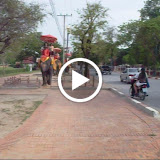
After resting the first day, we decided to spend the second day exploring the ruins. We took a local bus to the old section of town. Unlike at home, the local bus in this small town was a pickup truck with benches that lined the bed. Locals piled on with huge baskets of fruit and sacks of grain, and it cost less than a dollar for our 30 minute ride across the city.
When we arrived at the UNESCO site, we were surprised at the size of the area. We decided to rent bikes to explore the ruins and the park like surroundings. The weather was perfect, the skies were blue, and we were charmed by the serenity of the temples and the monks in their saffron colored robes.
The small towns were charming, and offered us a different view of life in Thailand. The further north we went, the more stunning the scenery, and we were excited to head to the northern capital of Chiang Mai. We had heard from others that it was a beautiful city, and we were about to see for ourselves just how right they were.
After winding our way through the northern bus station, we found the bus to Ayutthaya and managed to hop on just as it was pulling out. From there it was a quick 90 minute journey north to the historic Thai city. We found the P.U. Guesthouse, a charming place with a quirky name, and settled in.
Ayutthaya provides an interesting look at ancient Thailand. Ruins of the past are nestled in the midst of the modern city, and you never know what you might discover on a walk down the street. We visited the highlights of the town, sampled some of the local street food, and checked out the goods on offer at the local market. After two days of exploring, it was time to move on, and it was just a couple hours north to the town of Sukhothai.
Sukhothai is a UNESCO heritage site and has an amazing old town with a large collection of old Buddhist temples. We stayed in the new town, at a local guesthouse. We had a little cottage to ourselves, and a beautiful garden that we shared with four turtles, one cat, three kittens, and lots of fish and birds. It was incredibly peaceful and the family who ran the house was incredibly welcoming.
After resting the first day, we decided to spend the second day exploring the ruins. We took a local bus to the old section of town. Unlike at home, the local bus in this small town was a pickup truck with benches that lined the bed. Locals piled on with huge baskets of fruit and sacks of grain, and it cost less than a dollar for our 30 minute ride across the city.
When we arrived at the UNESCO site, we were surprised at the size of the area. We decided to rent bikes to explore the ruins and the park like surroundings. The weather was perfect, the skies were blue, and we were charmed by the serenity of the temples and the monks in their saffron colored robes.
The small towns were charming, and offered us a different view of life in Thailand. The further north we went, the more stunning the scenery, and we were excited to head to the northern capital of Chiang Mai. We had heard from others that it was a beautiful city, and we were about to see for ourselves just how right they were.
 |
| Ayuthaya and Sukothai |
Thursday, May 14, 2009
Krabi
Our trip to Krabi wasn’t quite as smooth as our previous bus trip. This time we took a private bus instead of a government bus. The fares were cheaper, and we soon discovered why. Though the seats were nice and comfortable, there was no bathroom, which makes a 6 hour bus ride seem really long. There was also no food, although they did stop at one of their restaurants so that you could give them more money to eat their food. Instead of going straight through to Krabi, the bus would stop along the way, picking up and dropping off local passengers, extending the journey by two hours. When we finally arrived in Krabi, we were ready for dinner, a shower, and a good night’s sleep.
The next day we went down to breakfast and asked at the hotel about local sea kayaking trips. We had read in our travel guide that the area was known for kayaking and it was something that we were both interested in trying. Our hotel had brochures from all the local companies so during breakfast we read through them and decided on a full day trip with kayaking in the morning and snorkeling in the afternoon. We booked the trip for the following day, and then went out to explore the town.
We found a great little local place for lunch. The local places tend to have the best food and the best prices, but they don’t usually have menus and the ones that do don’t have menus in English. Our method is to find a spot that is busy, look at what people are eating, and when we see something that looks good, point to it. The locals find it very entertaining that a couple of farang (foreigners) are interesting in eating the real local food, not the westernized versions that you often find at the larger places in town.
After lunch we walked to the bus station. Not wanting to get stuck on a private bus again, we wanted to book our ticket at the government station a few days in advance. Our book said that the station was 4 Km away and we thought it would make a nice walk. We got a little bit lost along the way, and 4 Km turned into 5 or 6. When we finally arrived at the bus station it was 6 pm. We walked up to the ticket window only to have it shut in our face. Apparently we would have to come back tomorrow.
We took a taxi back from the bus station, and when we were dropped off we were greeted by the hotel manager. Our kayaking trip for the next day had been cancelled due to weather. A huge storm was expected to hit the coast, and they were predicting rain for the next five days. Bummer! Undaunted, our hotel manager suggested a company that ran half day kayaking trips in an inlet about an hour away. The inlet would provide protection from the storm. We were disappointed to miss out on the snorkeling, but we still wanted to try to kayaking, so we agreed to the half day trip.
The next morning our guide picked us up at 8. We rode around and picked up a few more kayakers, and then headed about an hour north towards the inlet. They gave us coffee and tea while we filled out paperwork and got fitted into our life jackets. Then we settled into our kayaks and off we went. It took awhile for Leon and I to get used to paddling together, but we devised a system that worked and then we were really moving.
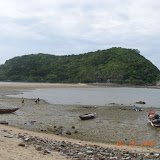
The scenery was spectacular. All around us these huge limestone cliffs rose out of the water, creating a pathway for us to paddle through. After about an hour of kayaking we were through the cliffs and into a mangrove forest. The going here was a little rougher. The mangrove forests are very dense and you have to manuvere your paddle around the branches above the water and the roots below. It is easy to get caught on a branch and tip. The passage ways are very narrow and there are a lot of sharp turns. Along with the challenges, the mangrove forest also brought some pleasant surprises.
There are two types of monkeys that live in the forests near Krabi. The gibbons are small, black tree dwellers. They rarely come out of the trees, but fly through them singing. We were lucky enough to see one swinging over our heads. The long tail macaws are much more social. They came down to share our snack of fresh pineapple and watermelon. One hopped aboard our guide’s boat, and then swam to our kayak to get more fruit and some fresh water. He helped himself to Leon’s water bottle, and then caught a ride on the front of our boat to the edge of the forest, and then hopped off to join his family.
The next day we went down to breakfast and asked at the hotel about local sea kayaking trips. We had read in our travel guide that the area was known for kayaking and it was something that we were both interested in trying. Our hotel had brochures from all the local companies so during breakfast we read through them and decided on a full day trip with kayaking in the morning and snorkeling in the afternoon. We booked the trip for the following day, and then went out to explore the town.
We found a great little local place for lunch. The local places tend to have the best food and the best prices, but they don’t usually have menus and the ones that do don’t have menus in English. Our method is to find a spot that is busy, look at what people are eating, and when we see something that looks good, point to it. The locals find it very entertaining that a couple of farang (foreigners) are interesting in eating the real local food, not the westernized versions that you often find at the larger places in town.
After lunch we walked to the bus station. Not wanting to get stuck on a private bus again, we wanted to book our ticket at the government station a few days in advance. Our book said that the station was 4 Km away and we thought it would make a nice walk. We got a little bit lost along the way, and 4 Km turned into 5 or 6. When we finally arrived at the bus station it was 6 pm. We walked up to the ticket window only to have it shut in our face. Apparently we would have to come back tomorrow.
We took a taxi back from the bus station, and when we were dropped off we were greeted by the hotel manager. Our kayaking trip for the next day had been cancelled due to weather. A huge storm was expected to hit the coast, and they were predicting rain for the next five days. Bummer! Undaunted, our hotel manager suggested a company that ran half day kayaking trips in an inlet about an hour away. The inlet would provide protection from the storm. We were disappointed to miss out on the snorkeling, but we still wanted to try to kayaking, so we agreed to the half day trip.
The next morning our guide picked us up at 8. We rode around and picked up a few more kayakers, and then headed about an hour north towards the inlet. They gave us coffee and tea while we filled out paperwork and got fitted into our life jackets. Then we settled into our kayaks and off we went. It took awhile for Leon and I to get used to paddling together, but we devised a system that worked and then we were really moving.
The scenery was spectacular. All around us these huge limestone cliffs rose out of the water, creating a pathway for us to paddle through. After about an hour of kayaking we were through the cliffs and into a mangrove forest. The going here was a little rougher. The mangrove forests are very dense and you have to manuvere your paddle around the branches above the water and the roots below. It is easy to get caught on a branch and tip. The passage ways are very narrow and there are a lot of sharp turns. Along with the challenges, the mangrove forest also brought some pleasant surprises.
There are two types of monkeys that live in the forests near Krabi. The gibbons are small, black tree dwellers. They rarely come out of the trees, but fly through them singing. We were lucky enough to see one swinging over our heads. The long tail macaws are much more social. They came down to share our snack of fresh pineapple and watermelon. One hopped aboard our guide’s boat, and then swam to our kayak to get more fruit and some fresh water. He helped himself to Leon’s water bottle, and then caught a ride on the front of our boat to the edge of the forest, and then hopped off to join his family.
 |
| Krabi |
Thursday, May 7, 2009
The Beach
We took an overnight bus from Bangkok to Koh Pha-ngan. In India, our experience with buses had been less than pleasant, but we had been assured that the buses in Thailand were “five-star all the way” so we decided to give it a go. We arrived at the bus station a little later than we planned, and didn’t have time to grab a meal before boarding the bus. We were hungry, so we made a quick stop at the bus stop Dunkin’ Donuts and took some pastries to go.
While I wouldn’t call the buses five-star, they were pretty nice. We were greeted at the door by the bus stewardess, who looked just like a 1950s airline stewardess with her little uniform and hat. She showed us to our seats and we settled in for the journey. Shortly after we left, she started the movie; a ridiculous French film that I couldn’t bear to watch. Halfway through the entertainment, it was juice boxes and boxed lunches. In the morning, we were given moist toilettes and coffee to wake us up before transferring to the ferry. The cost of the ferry was included in our bus fare. We spent the three hour journey roaming the deck to enjoy the view and napping in the comfy seating area. All this for the bargain price of $21 per person. Greyhound could take some lessons here.
Our hotel in Koh Pha-ngan was the perfect beach retreat. We had a secluded bungalow with a front porch that overlooked the pier. A hammock provided the perfect place to read a book or enjoy the spectacular sunsets, and a kitty that we named Honey came by every morning and evening to sit with us.
Our first day in Koh Pha-ngan we went to visit sunset beach, famous for the monthly full moon parties. The sand was white and soft, and the water seemed almost too perfect to be natural. The water was crystal clear blue, warm, and had not a single wave. We laid out an enjoyed the sun, with an occasional dip in the clear waters.
The next day in Koh Pha-ngan we went on a longboat trip around the island. Our first stop was a waterfall. We landed on the beach, and hiked about 1km to the falls. There was took a dip in the cool waters and climbed to the top of the falls to enjoy the spectacular view. Our next stop was Bottle Beach, a pristine area that can only be reached by boat. The remote island has no roads, and it is possible to lie on Bottle Beach as the only visitors. We were supposed to end our trip with snorkeling at Ko Ma, but a huge storm forced us to turn back. We hurried through the torrential downpour, huddling together to try and keep warm and as dry as possible. The rain stopped just as suddenly as it started, and we stopped at a nearby beach for snorkeling. Then it was home for a buffet of green curry, yellow curry, and sweet and sour vegetables.
Our fourth day on the island, Leon and I rented a scooter to explore the island. We had originally planned to head to Ko Ma for some snorkeling, but winds were high and the waters were rough. Instead we decided to explore the few roads that exist on the island. We found a great local restaurant, and saw some prawn farmers hard at work. It was interesting to see the local villages scattered between the areas that are dominated by the tourist industry.
Having seen the entire island, we decided to head across the country to see the Andaman Coast exploring the north. We found a bus the Krabi that left the following morning. As we boarded the ferry, we were relaxed, revived, and ready to explore.
While I wouldn’t call the buses five-star, they were pretty nice. We were greeted at the door by the bus stewardess, who looked just like a 1950s airline stewardess with her little uniform and hat. She showed us to our seats and we settled in for the journey. Shortly after we left, she started the movie; a ridiculous French film that I couldn’t bear to watch. Halfway through the entertainment, it was juice boxes and boxed lunches. In the morning, we were given moist toilettes and coffee to wake us up before transferring to the ferry. The cost of the ferry was included in our bus fare. We spent the three hour journey roaming the deck to enjoy the view and napping in the comfy seating area. All this for the bargain price of $21 per person. Greyhound could take some lessons here.
Our hotel in Koh Pha-ngan was the perfect beach retreat. We had a secluded bungalow with a front porch that overlooked the pier. A hammock provided the perfect place to read a book or enjoy the spectacular sunsets, and a kitty that we named Honey came by every morning and evening to sit with us.
Our first day in Koh Pha-ngan we went to visit sunset beach, famous for the monthly full moon parties. The sand was white and soft, and the water seemed almost too perfect to be natural. The water was crystal clear blue, warm, and had not a single wave. We laid out an enjoyed the sun, with an occasional dip in the clear waters.
The next day in Koh Pha-ngan we went on a longboat trip around the island. Our first stop was a waterfall. We landed on the beach, and hiked about 1km to the falls. There was took a dip in the cool waters and climbed to the top of the falls to enjoy the spectacular view. Our next stop was Bottle Beach, a pristine area that can only be reached by boat. The remote island has no roads, and it is possible to lie on Bottle Beach as the only visitors. We were supposed to end our trip with snorkeling at Ko Ma, but a huge storm forced us to turn back. We hurried through the torrential downpour, huddling together to try and keep warm and as dry as possible. The rain stopped just as suddenly as it started, and we stopped at a nearby beach for snorkeling. Then it was home for a buffet of green curry, yellow curry, and sweet and sour vegetables.
Our fourth day on the island, Leon and I rented a scooter to explore the island. We had originally planned to head to Ko Ma for some snorkeling, but winds were high and the waters were rough. Instead we decided to explore the few roads that exist on the island. We found a great local restaurant, and saw some prawn farmers hard at work. It was interesting to see the local villages scattered between the areas that are dominated by the tourist industry.
Having seen the entire island, we decided to head across the country to see the Andaman Coast exploring the north. We found a bus the Krabi that left the following morning. As we boarded the ferry, we were relaxed, revived, and ready to explore.
 |
| Koh Pha-nagn |
Subscribe to:
Posts (Atom)

