Jaipur is known as the “Pink City”. The story goes that the old city was originally built with cheap materials due to a lack of funds. To cover up the shoddy work, the whole city was painted pink; every wall, every building. Though the city underwent repairs in the late 19th century, the pink color remained, and the old city it still easily recognizable by the rose colored walls.
We only had one full day in Jaipur, so once we settled into our guesthouse we headed straight out for lunch. At the restaurant, we met a British traveler, Claire. She was traveling alone and we invited her to spend the day exploring the city with us. We negotiated a rickshaw, and found our way to the pink city walls.
Our first stop was a bizarre one. In the early 19th century, the king of Jaipur had an interest in astrology. It was widely believed at the time that astrology could be used as a tool to predict everything from wars, to auspicious marriage days. Because of this belief, the king built a park with a number of tools designed to track the movements of the stars so that people could use this information to chart their astrological course. The park, and the tools are still standing within the walls of the pink city. While they are no longer used to predict wars, the tools themselves are remarkable accurate a tracking the movements of the heavenly bodies.
We wandered around the bazaars for a few hours, seeing the city palace, and some famous observation sites throughout the city. As sunset approached, we found ourselves in a rickshaw again, this time heading out 3 km outside of Jaipur to see the “Monkey Temple”. The Monkey Temple is a series of temples in a narrow ravine on the outskirts of town. Though some of the temples are still in use, the area is now more famous for the monkey population. Nearly 5000 monkeys live within the temples in the ravine, and they are the reason that most tourists visit the area. A vendor outside the temple gates sells peanuts and other treats which you can give to the monkeys who live inside. For those of us who live in a country where monkeys are only found in zoos, it is an incredible experience.
The monkeys are very used to people, and will romp and play only a few feet from where you are walking. We purchased some peanuts for the monkeys from the vendor outside. We started out by throwing them on the ground, but soon found that the monkeys will come and take the peanuts right out of your hand. They are very gentle, and will hold your hand while they use their second hand to stuff as many peanuts as possible into their cheeks. Once they are stuffed, they will shell and eat the peanuts one by one, just the way that we would.
We took our time passing out a pound of peanuts, and then we rode back into town. We had a leisurely dinner, and then walked Claire back to her hotel. On the way home, we stopped for a treat; Baskin Robbins! The next day we had a brutal 17 hour train ride, but we found our trip to Jaipur to be not only short but sweet.
p.s. our pictures from Jaipur were killed by a horrible virus.
Monday, April 20, 2009


The Venice of India
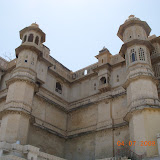
Rajasthan was not on our original itinerary, but as we travelled around India, the locals told us that no trip to India would be complete without a visit to the famous northwestern state. We searched our book and it listed Udaipur as one of the most beautiful cities in the country, so after another overnight train ride, we found ourselves with four days to spend in the “Venice of India”.
We were lucky on arrival to meet a local rickshaw driver named Billu. He offered us a fair price for a ride into town (usually you have to haggle to get only slightly ripped off) and patiently drove us to a few hotels to check out options. We settled on the Panorama guesthouse, a small, family run hotel with quaint rooms and a rooftop restaurant overlooking Lake Pichola.
After settling into our rooms, we set out on foot to explore the town, and find a post office. We wandered through the cloth markets, the produce market, the spice market, and the oil market. We walked down a side street where vendors were making fresh potato chips, sold for 5 rupees a bag and women were sorting huge barrels of chilies so hot you could smell it.
As we found to be the case in most of India, the people in these markets were friendly and welcoming. They happily posed for pictures that we took of them, and explained the local crafts. The spice vendors explained to us the different types of fresh tea leaves available at their stalls. Leon, stopped at a local electronics repair stall to have a pair of headphones fixed. He was told the repair would be five minutes and would cost 10 rupees, but while we waited wouldn’t we please sit down and have a glass of chai and tell about our travels? We met local families, and made new friends, and at the end of the day we wandered back to our hotel, charmed with Udaipur.
The next day, we decided to take a tour of the city with our rickshaw driver, Billu. For a set price of 550 rupees ($11) he would drive the three of us to all the major sights in Udaipur and anywhere else we asked to go. He took us to the “Milk Lake” where the locals go to bathe. Then we took a boat ride to a park that sits on a small island in the middle of a lake. After that, it was off to another park, this one built for the Royal Princesses and their handmaidens to enjoy. We ended our day at the Monsoon Palace. The famous palace, built in 1883, was built high on a mountain overlooking the city. The royal family built it as a summer residence, with the thought that they could spend the monsoon season there, looking out over their kingdom. Unfortunately, just before the palace was completed, they realized that there was no way to pump water to the palace. Construction was stopped, and no one ever lived there. Still, the nearly finished palace sits, high on a hill, surrounded by a wildlife sanctuary. The view from the top was spectacular, and a perfect way to end our day.
Our third day in Udaipur was also busy. I got up early to get an acupressure massage. It was excruciatingly painful, and unlike any massage that I have ever experienced, but I left feeling exhilarated and relaxed. Next up; an Indian cooking class. The owner of our hotel offered cooking classes taught by his wife in their home. We had picked the menu the day before, and now it was off to learn how to cook a full Indian meal. The three of us crowded into the kitchen and learned how to make chai, vegetable kofta, mixed vegetable curry, raita, vegetable fried rice, potato pakora, chapatti, and galub jamon. After the lesson, we ate all the food, and we left with full tummies and happy hearts.
On our final day in Udaipur, we went to see the City Palace. The palace was once the home of the royal family of Udaipur, but was now a museum. The exhibits explained the history of the city, and gave an image of royal palace life into the modern age. After the palace it was lunch, and some errands before catching yet another train. This time we were off to Jaipur, our last new city on our journey through India.
We were lucky on arrival to meet a local rickshaw driver named Billu. He offered us a fair price for a ride into town (usually you have to haggle to get only slightly ripped off) and patiently drove us to a few hotels to check out options. We settled on the Panorama guesthouse, a small, family run hotel with quaint rooms and a rooftop restaurant overlooking Lake Pichola.
After settling into our rooms, we set out on foot to explore the town, and find a post office. We wandered through the cloth markets, the produce market, the spice market, and the oil market. We walked down a side street where vendors were making fresh potato chips, sold for 5 rupees a bag and women were sorting huge barrels of chilies so hot you could smell it.
As we found to be the case in most of India, the people in these markets were friendly and welcoming. They happily posed for pictures that we took of them, and explained the local crafts. The spice vendors explained to us the different types of fresh tea leaves available at their stalls. Leon, stopped at a local electronics repair stall to have a pair of headphones fixed. He was told the repair would be five minutes and would cost 10 rupees, but while we waited wouldn’t we please sit down and have a glass of chai and tell about our travels? We met local families, and made new friends, and at the end of the day we wandered back to our hotel, charmed with Udaipur.
The next day, we decided to take a tour of the city with our rickshaw driver, Billu. For a set price of 550 rupees ($11) he would drive the three of us to all the major sights in Udaipur and anywhere else we asked to go. He took us to the “Milk Lake” where the locals go to bathe. Then we took a boat ride to a park that sits on a small island in the middle of a lake. After that, it was off to another park, this one built for the Royal Princesses and their handmaidens to enjoy. We ended our day at the Monsoon Palace. The famous palace, built in 1883, was built high on a mountain overlooking the city. The royal family built it as a summer residence, with the thought that they could spend the monsoon season there, looking out over their kingdom. Unfortunately, just before the palace was completed, they realized that there was no way to pump water to the palace. Construction was stopped, and no one ever lived there. Still, the nearly finished palace sits, high on a hill, surrounded by a wildlife sanctuary. The view from the top was spectacular, and a perfect way to end our day.
Our third day in Udaipur was also busy. I got up early to get an acupressure massage. It was excruciatingly painful, and unlike any massage that I have ever experienced, but I left feeling exhilarated and relaxed. Next up; an Indian cooking class. The owner of our hotel offered cooking classes taught by his wife in their home. We had picked the menu the day before, and now it was off to learn how to cook a full Indian meal. The three of us crowded into the kitchen and learned how to make chai, vegetable kofta, mixed vegetable curry, raita, vegetable fried rice, potato pakora, chapatti, and galub jamon. After the lesson, we ate all the food, and we left with full tummies and happy hearts.
On our final day in Udaipur, we went to see the City Palace. The palace was once the home of the royal family of Udaipur, but was now a museum. The exhibits explained the history of the city, and gave an image of royal palace life into the modern age. After the palace it was lunch, and some errands before catching yet another train. This time we were off to Jaipur, our last new city on our journey through India.
 |
| Udaipur |
Sunday, April 19, 2009
Agra
Our journey to Agra was exhausting. We had left Corbett National park on a 10 pm sleeper train and managed to grab a few hours of sleep before we arrived in Delhi at 4 am. We then had to pile into a rickshaw and journey across town to a different train station to catch our 5:30 am train to Agra. Three hours, and a short nap later, we found ourselves in Agra, home of the Taj Mahal. We were exhausted, but there was not rest for the weary. It was Thursday morning, and since the Taj is closed on Fridays we had only one day to see one of the great wonders of the world.
Off to the hotel, quick breakfast and shower, and then away we went. I knew that I should feel tired, but between the chai and my excitement at seeing the Taj I was buzzing. We picked a hotel that was only a few blocks from the Taj Mahal, and the walk there filled me with anticipation. You can’t really see the Taj as you approach due to the surrounding wall, but you know that you are getting closer as you walk down the street loaded with souvenir shops.
The ticket for the Taj Mahal is expensive by Indian standards, 750 rupees ($15) for foreign visitors. When you are used to paying less than that for a hotel room, the price seems exorbitant, but once you have seen it you realize that it is worth every penny (even without the free bottle of water and shoe covers that you get). Locals pay much less, about 15 rupees, which is a common practice in India. It keeps the national treasures affordable for the locals and still provides the government with enough funds to maintain the monuments.
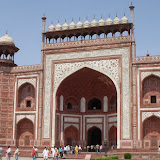
Security is tight at the Taj Mahal. Visitors aren’t allowed to bring in much, no large bags, no guide books, no outside food or drink. Everyone must pass through a metal detector and a personal search before entering the sight. One you walk through the security check point, you find yourself in the outer courtyard. It is a large square courtyard with four gates, three leading out to the city, and one leading in to the Taj Mahal. You still can’t see the Taj from here, and by this point the anticipation was overwhelming. We walked toward the north gate, and through the arch of the wall, you see your first glimpse of the tomb.
The Taj Mahal is a monument to love, built by a maharaja for his favorite wife after her death. It is made entirely of marble, with semi-precious stone inlay. The building itself, and the grounds are perfectly symmetrical, and the complex is meant to represent the paradise as described in the Koran, with rivers of milk and honey. The building glows in the light of the sun, and the perfect symmetry and tranquil atmosphere give the place the feeling of another world. It was so beautiful, it brought tears to my eyes. The story says that the Maharaja was so consumed by grief that he dedicated years (one source said 13 another 20) and millions of rupees to building the final resting place for his beloved wife. His son, outraged at the money that was being spent, ousted his father and imprisoned him in Agra fort, a few kilometers up the river and the king spent his last days staring out the window at the wonder he had built. It is romantic, and tragic, and you feel those things when you are there.
We spent three hours admiring the intricate carvings and stone inlay work. We wandered through the building, and sat in the gardens soaking up the feeling of being in a place so magical. It was late afternoon, and we were hungry and tired, but I left with tears in my eyes, glancing over my shoulder for one last look at something I never thought I would see.
We decided to leave from a different gate than the one we had entered to explore a different neighborhood, and the feeling of peace and happiness was immediately shattered by the crush of vendors that greeted us as we left the gate. We found ourselves surrounded by a mob of young men trying to lure us into their shops. We fought our way through to the end of the street and found a rooftop restaurant serving a lunchtime thali with a view of the Taj. We filled up on rice, a chickpea curry, and dal and then headed back to our room for a little rest. The next day would bring another train ride and we needed all the rest we could get.
Off to the hotel, quick breakfast and shower, and then away we went. I knew that I should feel tired, but between the chai and my excitement at seeing the Taj I was buzzing. We picked a hotel that was only a few blocks from the Taj Mahal, and the walk there filled me with anticipation. You can’t really see the Taj as you approach due to the surrounding wall, but you know that you are getting closer as you walk down the street loaded with souvenir shops.
The ticket for the Taj Mahal is expensive by Indian standards, 750 rupees ($15) for foreign visitors. When you are used to paying less than that for a hotel room, the price seems exorbitant, but once you have seen it you realize that it is worth every penny (even without the free bottle of water and shoe covers that you get). Locals pay much less, about 15 rupees, which is a common practice in India. It keeps the national treasures affordable for the locals and still provides the government with enough funds to maintain the monuments.
Security is tight at the Taj Mahal. Visitors aren’t allowed to bring in much, no large bags, no guide books, no outside food or drink. Everyone must pass through a metal detector and a personal search before entering the sight. One you walk through the security check point, you find yourself in the outer courtyard. It is a large square courtyard with four gates, three leading out to the city, and one leading in to the Taj Mahal. You still can’t see the Taj from here, and by this point the anticipation was overwhelming. We walked toward the north gate, and through the arch of the wall, you see your first glimpse of the tomb.
The Taj Mahal is a monument to love, built by a maharaja for his favorite wife after her death. It is made entirely of marble, with semi-precious stone inlay. The building itself, and the grounds are perfectly symmetrical, and the complex is meant to represent the paradise as described in the Koran, with rivers of milk and honey. The building glows in the light of the sun, and the perfect symmetry and tranquil atmosphere give the place the feeling of another world. It was so beautiful, it brought tears to my eyes. The story says that the Maharaja was so consumed by grief that he dedicated years (one source said 13 another 20) and millions of rupees to building the final resting place for his beloved wife. His son, outraged at the money that was being spent, ousted his father and imprisoned him in Agra fort, a few kilometers up the river and the king spent his last days staring out the window at the wonder he had built. It is romantic, and tragic, and you feel those things when you are there.
We spent three hours admiring the intricate carvings and stone inlay work. We wandered through the building, and sat in the gardens soaking up the feeling of being in a place so magical. It was late afternoon, and we were hungry and tired, but I left with tears in my eyes, glancing over my shoulder for one last look at something I never thought I would see.
We decided to leave from a different gate than the one we had entered to explore a different neighborhood, and the feeling of peace and happiness was immediately shattered by the crush of vendors that greeted us as we left the gate. We found ourselves surrounded by a mob of young men trying to lure us into their shops. We fought our way through to the end of the street and found a rooftop restaurant serving a lunchtime thali with a view of the Taj. We filled up on rice, a chickpea curry, and dal and then headed back to our room for a little rest. The next day would bring another train ride and we needed all the rest we could get.
 |
| Agra |
Elephants and tigers and bears, oh my!
We took a flight from Calcutta to Delhi, and then from there we took an overnight train to Corbett National Park. We arrived at the train station at 4:55 am, exhausted, but ready for adventure. We were met at the station by our friendly guide, Mohin. We stopped for a quick glass of chai, and then continued on to the hotel to settle into our room and rest before our day’s adventures. At 11, Mohin came to get us and took us for a walk through the outskirts of the park to the banks of a local river. A school group was there doing wilderness activities like repelling and river crossing. We watched them for awhile before heading back to get lunch. We ate a light soup and salad meal, and then went to meet our ride for our first forest safari.
Our first trip into the forest was an elephant safari. Our ride was a 36 year old elephant named Kanchan and her handler. Four of us rode on her back, sitting sideways on a saddle. Her handler sat in front of us on her shoulders. To board the elephant we had to walk up a set of stairs to a platform, and climb on. Once everyone was safely aboard, we set out into the forest.
Kanchan plodded slowly through the forest, following a path that was familiar to her. She seemed unaware of our excitement, stopping every so often to grab a snack off a nearby tree branch. Meanwhile, we were looking around us anxiously, searching for signs of the elusive tigers that inhabit the area. We had heard stories before we left about the man-eater who had been trapped only two months before after killing a local villager, and our guide told tales of handlers who had been pulled right off of their elephants by the mighty cats. We searched the bushes, and caught our breath at every sound, half hoping to spot a tiger, and half afraid to. Our guide taught us to listen to the screams of the monkey, who spot the tigers from the treetops and then warn the other animals to be on the alert, and we walked past the bones of deer that had been dinner for one hungry animal. We spent two hours in the forest, and without spotting a tiger. We were disappointed, but only slightly. We had so much fun riding Kanchan, and at the end of our tour she let us pet her, which we all thought was adorable.
Our second day began with a 5 am wake-up call. We quickly got dressed and piled into the resort jeep. Today we were going to drive further into the park on a jeep safari. We stopped at the park gates to fill out our admission paperwork and pick-up our guide/tracker. It wasn’t long before our guide yelled excitedly for our driver to stop. We all got out to look at his find, fresh tracks from a male tiger! Something was close by. Now we were awake. We were searching the trees with our binoculars looking for clues. There were plenty of spotted deer (referred to as tiger food by our guide), a wild boar, loads of monkeys, and even some wild peacocks. We crossed a river, and then we stopped again; another tiger print, this time from a female. We stopped to listen carefully. We heard the sounds of the monkeys and the peacocks, and then all of a sudden, from far away, a roar! It was incredible! We didn’t see the tiger, but we knew that he was there, and probably saw us. That was enough to send shivers up my spine. We spent nearly three hours searching the forest before calling it a day and heading back to town for a late breakfast. We spent the day relaxing and enjoying the peace and quiet provided by the country side and the fresh air (a rarity in India). We had a train at night that we take us back to Delhi and then on to Agra. It was going to be a long couple of days.
Our first trip into the forest was an elephant safari. Our ride was a 36 year old elephant named Kanchan and her handler. Four of us rode on her back, sitting sideways on a saddle. Her handler sat in front of us on her shoulders. To board the elephant we had to walk up a set of stairs to a platform, and climb on. Once everyone was safely aboard, we set out into the forest.
Kanchan plodded slowly through the forest, following a path that was familiar to her. She seemed unaware of our excitement, stopping every so often to grab a snack off a nearby tree branch. Meanwhile, we were looking around us anxiously, searching for signs of the elusive tigers that inhabit the area. We had heard stories before we left about the man-eater who had been trapped only two months before after killing a local villager, and our guide told tales of handlers who had been pulled right off of their elephants by the mighty cats. We searched the bushes, and caught our breath at every sound, half hoping to spot a tiger, and half afraid to. Our guide taught us to listen to the screams of the monkey, who spot the tigers from the treetops and then warn the other animals to be on the alert, and we walked past the bones of deer that had been dinner for one hungry animal. We spent two hours in the forest, and without spotting a tiger. We were disappointed, but only slightly. We had so much fun riding Kanchan, and at the end of our tour she let us pet her, which we all thought was adorable.
Our second day began with a 5 am wake-up call. We quickly got dressed and piled into the resort jeep. Today we were going to drive further into the park on a jeep safari. We stopped at the park gates to fill out our admission paperwork and pick-up our guide/tracker. It wasn’t long before our guide yelled excitedly for our driver to stop. We all got out to look at his find, fresh tracks from a male tiger! Something was close by. Now we were awake. We were searching the trees with our binoculars looking for clues. There were plenty of spotted deer (referred to as tiger food by our guide), a wild boar, loads of monkeys, and even some wild peacocks. We crossed a river, and then we stopped again; another tiger print, this time from a female. We stopped to listen carefully. We heard the sounds of the monkeys and the peacocks, and then all of a sudden, from far away, a roar! It was incredible! We didn’t see the tiger, but we knew that he was there, and probably saw us. That was enough to send shivers up my spine. We spent nearly three hours searching the forest before calling it a day and heading back to town for a late breakfast. We spent the day relaxing and enjoying the peace and quiet provided by the country side and the fresh air (a rarity in India). We had a train at night that we take us back to Delhi and then on to Agra. It was going to be a long couple of days.
 |
| Corbett |
Saturday, April 18, 2009
Calcutta
I admit, none of us was particularly looking forward to our stay in Calcutta. We had been warned that it was large, dirty, overpopulated, impoverished, and had nothing to see, so our plan was to stay just long enough to find a way out. Instead the city defied all of our expectations. We found a reasonably priced hotel, in a cute little area of town. There were loads of cheap, tasty restaurants within walking distance, and any service that you could require; internet, laundry, passport photos, etc.
We spent most of our time in Calcutta, catching up on planning and taking care of trip business. We needed to book our next few rail tickets, purchase new SIM cards for the cell phones, do laundry, etc. and we left only the final day for sightseeing. When we did finally get around to leaving our charismatic neighborhood, we found the greater city to be clean and easy to get around. Calcutta has the only Subway system in India. It was cheap, clean, and efficient on par with the systems that we had seen throughout Europe. There was a large central park area, where the local residents gathered for walks, picnics, and pick-up cricket games. We visited Victoria Monument, an impressive structure with a museum documenting the history of India under British rule, and St. Paul’s Cathedral.
We stayed in Calcutta for four days, and though there weren’t many tourist sites, per se, we found Calcutta to be a lovely modern Indian city. It was large. It was crowded. There were areas were the poverty was heartbreaking, but it was nothing like we thought it would be. Once again, India managed o surprised us.
We spent most of our time in Calcutta, catching up on planning and taking care of trip business. We needed to book our next few rail tickets, purchase new SIM cards for the cell phones, do laundry, etc. and we left only the final day for sightseeing. When we did finally get around to leaving our charismatic neighborhood, we found the greater city to be clean and easy to get around. Calcutta has the only Subway system in India. It was cheap, clean, and efficient on par with the systems that we had seen throughout Europe. There was a large central park area, where the local residents gathered for walks, picnics, and pick-up cricket games. We visited Victoria Monument, an impressive structure with a museum documenting the history of India under British rule, and St. Paul’s Cathedral.
We stayed in Calcutta for four days, and though there weren’t many tourist sites, per se, we found Calcutta to be a lovely modern Indian city. It was large. It was crowded. There were areas were the poverty was heartbreaking, but it was nothing like we thought it would be. Once again, India managed o surprised us.
 |
| Kolkata |
A Taste of Family Life
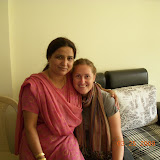
Our train ride from Hyderabad to Bhubaneswar was 23 hours, and we had plenty of time to get to know that people riding around us. Sitting across the aisle was a young Indian man and his mother. They struck up a friendly conversation about our travels and we talked to them for awhile. Nearing the city, we began to look in our guide book to find a hotel to stay in. Our new friends took notice, and insisted that we stay with them instead of spending money on a hotel. At first we demurred, saying that there was three of us and we couldn’t possible impose. They were persistent, and we finally agreed, although we were still feeling hesitant. Ferida, the mother, called home to let her daughter-in-law know that guests would be arriving for dinner, and before we could protest any further is was all arranged.
We took the short trip from the rail station to their home, which was a lovely 3 bedroom flat near the center of the city. They were a small family, just five members. Ferida’s husband had died of cancer the year before, leaving her with their two sons, Mispa and Salman. Mispa’s wife, and their maid Mousy also stayed in the flat. They had us put our bags into the guest room, and fed us a meal of biryani. It was our first home-cooked meal since South Africa, and it was delicious! Eager to please, the boys took us to meet their fried, Raju, and the five of us went out to explore Bhubaneswar at night. It was a Friday night, but the city is small, and there isn’t much to do except head to the mall, so that’s what we did. After a couple hours of checking out the local “hot spots” we went home. It was dinner time, and even though we had just eaten a few hours before, we couldn’t refuse the tasty meal.
Staying with the family gave us a unique opportunity to see the social structure of the home, which is quite different from ours. Women in India are very much respected and appreciated, but gender roles in India are still very clearly defined in a way that doesn’t exist in American these days. Of course as guests, these gender roles didn’t apply to us, and we were treated with the utmost respect and care. Meal times were strange for us because of the eating order. In America, everyone sits down to dinner together. While the host is usually responsible for preparation and clean-up, it is not unheard of for guest to help out in these areas. During our stay with the Khan family, there was a distinct order to the food service. As guests, we were served first, by the sons. Once we had finished eating, Mispa, the oldest son would eat, followed by the women and Salman. This felt very awkward to us, and after the first two meals, Mispa began eating with us at our invitation, but the woman would always eat last, and often not until we had gone to bed for the evening.
The sleeping arrangements were also strange. In America it is standard practice for guest to sleep in a guestroom/office, etc. or even on the couch. Rarely does a member of the family give up their room. In this case, Leon and I were given one room, Rachel another, and the five members of the Khan family slept in the remaining room together. Again this seemed awkward to us. The one room was plenty large enough for the three of us, and we tried insisting that we sleep this way, but they refused, saying that they wanted to give us our privacy.
Our first full day in Bhubaneswar was a Monday, and Mispa took that day off work so that he, Salman, ad their friend Raju could show us around. They took us to the Sun Temple, the most beautiful temple in the state of Orissa. Though centuries old, the temple was in pristine condition and the carvings and gardens were well worth the long drive. After our trip there, we went to the large Buddhist Temple that sits on a hill overlooking the city. The view from the top was spectacular. Our final stop was the caves near town. Nowhere near as large or impressive as the Ellora caves, they did provide a nice place to sit and watch the sunset over the city.
Our second day in Bhubaneswar, the boys took us to the zoo. I was hesitant to go, because I was unsure of what conditions would be at a zoo in a developing country, but curiosity and manners led us to go. We packed (or rather the ladies packed) a picnic lunch for us, and we enjoyed our meal in a shady park in front of the zoo before walking to see the exhibits. The facilities were not up to the standards that one sees in an American zoo, but they weren’t as bad as I had imagined either, and there were noticeable efforts to improve the animal welfare.
After three nights in Bhubaneswar, we were ready to move on. We loved staying with the Khans, but we didn’t want to overstay our welcome, and our time in India was coming to a close quicker than we had thought possible. We boarded the train to Calcutta (with another packed lunch) and headed even further north.
We took the short trip from the rail station to their home, which was a lovely 3 bedroom flat near the center of the city. They were a small family, just five members. Ferida’s husband had died of cancer the year before, leaving her with their two sons, Mispa and Salman. Mispa’s wife, and their maid Mousy also stayed in the flat. They had us put our bags into the guest room, and fed us a meal of biryani. It was our first home-cooked meal since South Africa, and it was delicious! Eager to please, the boys took us to meet their fried, Raju, and the five of us went out to explore Bhubaneswar at night. It was a Friday night, but the city is small, and there isn’t much to do except head to the mall, so that’s what we did. After a couple hours of checking out the local “hot spots” we went home. It was dinner time, and even though we had just eaten a few hours before, we couldn’t refuse the tasty meal.
Staying with the family gave us a unique opportunity to see the social structure of the home, which is quite different from ours. Women in India are very much respected and appreciated, but gender roles in India are still very clearly defined in a way that doesn’t exist in American these days. Of course as guests, these gender roles didn’t apply to us, and we were treated with the utmost respect and care. Meal times were strange for us because of the eating order. In America, everyone sits down to dinner together. While the host is usually responsible for preparation and clean-up, it is not unheard of for guest to help out in these areas. During our stay with the Khan family, there was a distinct order to the food service. As guests, we were served first, by the sons. Once we had finished eating, Mispa, the oldest son would eat, followed by the women and Salman. This felt very awkward to us, and after the first two meals, Mispa began eating with us at our invitation, but the woman would always eat last, and often not until we had gone to bed for the evening.
The sleeping arrangements were also strange. In America it is standard practice for guest to sleep in a guestroom/office, etc. or even on the couch. Rarely does a member of the family give up their room. In this case, Leon and I were given one room, Rachel another, and the five members of the Khan family slept in the remaining room together. Again this seemed awkward to us. The one room was plenty large enough for the three of us, and we tried insisting that we sleep this way, but they refused, saying that they wanted to give us our privacy.
Our first full day in Bhubaneswar was a Monday, and Mispa took that day off work so that he, Salman, ad their friend Raju could show us around. They took us to the Sun Temple, the most beautiful temple in the state of Orissa. Though centuries old, the temple was in pristine condition and the carvings and gardens were well worth the long drive. After our trip there, we went to the large Buddhist Temple that sits on a hill overlooking the city. The view from the top was spectacular. Our final stop was the caves near town. Nowhere near as large or impressive as the Ellora caves, they did provide a nice place to sit and watch the sunset over the city.
Our second day in Bhubaneswar, the boys took us to the zoo. I was hesitant to go, because I was unsure of what conditions would be at a zoo in a developing country, but curiosity and manners led us to go. We packed (or rather the ladies packed) a picnic lunch for us, and we enjoyed our meal in a shady park in front of the zoo before walking to see the exhibits. The facilities were not up to the standards that one sees in an American zoo, but they weren’t as bad as I had imagined either, and there were noticeable efforts to improve the animal welfare.
After three nights in Bhubaneswar, we were ready to move on. We loved staying with the Khans, but we didn’t want to overstay our welcome, and our time in India was coming to a close quicker than we had thought possible. We boarded the train to Calcutta (with another packed lunch) and headed even further north.
 |
| Bubhanesware |
Monday, April 13, 2009
Hyderabad
Our first night in Hyderabad, we walked around the busy Lad Bazaar area. The area is known for having everything one would need for a full Indian wedding, and the shops are overflowing with silk sarees, henna, and jewelry shops carrying bangles and pearls. I bargained for a pair of beaded Indian shoes, and some bangles, which every Indian woman from birth to death seems to be wearing. The area around the bazaar was filled with street vendors selling everything from snacks to underwear and provides for hours of free entertainment. You can walk along the street, examining the wares, laughing at the children trying to sell you school books or the old men insisting that you need a saree for your stay in India. Tiring of the market, we decided to go for dinner, and we delighted to find that Hyderabad had a McDonalds! We were dying to see what the menu of McDonald’s would be in a country were more that 90% of the people don’t eat beef. The big seller here in the McVeggie Combo, which comes with masala fries. The “burger” is actually pretty good, and is something that I would eat at home if our McDonald’s had it. Other than the menu, the Golden Arches was just what you would find at home. There were smiling families, happy meals, and even a children’s birthday party. Ronald McDonald sat out front on a bench for photo ops and you could still finish your meal with a McFlurry.
Our second day in Hyderabad, we took a trip to Ramoji Film Studio. Listed in the Guinness book of World records as the world’s largest film studio, Ramoji is something like a poor man’s Universal Studios. There is a studio tour, which is takes you around to look at the various film sets. Most of the tour was in Hindi, but we got the gist of what was said by looking at the sets. Unlike American movies, which are filmed a lot on location these days, almost all Indian films are made exclusively in studios. Also, the budgets are considerably lower, with the average film budget a mere $1 million, unheard of by American standards. Once you finish the studio tour, there is a theme park area, which has only three attractions. You visit the attractions in order, and are allowed to visit each attraction only once. After the attractions, one which was an eerie copy of “It’s A Small World” we decided to get lunch. We shelled out 99 rupees (about $2) for an all-you-can eat Indian/Chinese buffet. We had just sat down at a table to eat, when we were rudely interrupted by a monkey. He stormed right up to the table; stole food off Leon’s plate, then came after mine. I screamed and pushed the plate towards him. He grabbed a handful and jumped off the table to consume our lunch! Leon was yelling, “Bad monkey!” and I was afraid that he would get bitten. We moved and found a table inside, and finished our lunch. After a long bus ride home, we were exhausted. Another crazy day in India.
Our last day in Hyderabad, we visited the Golconda Fort. A huge fort overlooking the city, we walked for hours through the old ramparts and admired the view from the top. What a beautiful view! We left the fort and headed to the train station to catch the train to Bhubaneswar. We weren’t looking forward to the 23 hour train ride, but we were ready to move on and experience a new city.
Our second day in Hyderabad, we took a trip to Ramoji Film Studio. Listed in the Guinness book of World records as the world’s largest film studio, Ramoji is something like a poor man’s Universal Studios. There is a studio tour, which is takes you around to look at the various film sets. Most of the tour was in Hindi, but we got the gist of what was said by looking at the sets. Unlike American movies, which are filmed a lot on location these days, almost all Indian films are made exclusively in studios. Also, the budgets are considerably lower, with the average film budget a mere $1 million, unheard of by American standards. Once you finish the studio tour, there is a theme park area, which has only three attractions. You visit the attractions in order, and are allowed to visit each attraction only once. After the attractions, one which was an eerie copy of “It’s A Small World” we decided to get lunch. We shelled out 99 rupees (about $2) for an all-you-can eat Indian/Chinese buffet. We had just sat down at a table to eat, when we were rudely interrupted by a monkey. He stormed right up to the table; stole food off Leon’s plate, then came after mine. I screamed and pushed the plate towards him. He grabbed a handful and jumped off the table to consume our lunch! Leon was yelling, “Bad monkey!” and I was afraid that he would get bitten. We moved and found a table inside, and finished our lunch. After a long bus ride home, we were exhausted. Another crazy day in India.
Our last day in Hyderabad, we visited the Golconda Fort. A huge fort overlooking the city, we walked for hours through the old ramparts and admired the view from the top. What a beautiful view! We left the fort and headed to the train station to catch the train to Bhubaneswar. We weren’t looking forward to the 23 hour train ride, but we were ready to move on and experience a new city.
 |
| Hyderabad |
Subscribe to:
Posts (Atom)

