Sunday, April 19, 2009

Agra

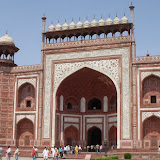
Our journey to Agra was exhausting. We had left Corbett National park on a 10 pm sleeper train and managed to grab a few hours of sleep before we arrived in Delhi at 4 am. We then had to pile into a rickshaw and journey across town to a different train station to catch our 5:30 am train to Agra. Three hours, and a short nap later, we found ourselves in Agra, home of the Taj Mahal. We were exhausted, but there was not rest for the weary. It was Thursday morning, and since the Taj is closed on Fridays we had only one day to see one of the great wonders of the world.
Off to the hotel, quick breakfast and shower, and then away we went. I knew that I should feel tired, but between the chai and my excitement at seeing the Taj I was buzzing. We picked a hotel that was only a few blocks from the Taj Mahal, and the walk there filled me with anticipation. You can’t really see the Taj as you approach due to the surrounding wall, but you know that you are getting closer as you walk down the street loaded with souvenir shops.
The ticket for the Taj Mahal is expensive by Indian standards, 750 rupees ($15) for foreign visitors. When you are used to paying less than that for a hotel room, the price seems exorbitant, but once you have seen it you realize that it is worth every penny (even without the free bottle of water and shoe covers that you get). Locals pay much less, about 15 rupees, which is a common practice in India. It keeps the national treasures affordable for the locals and still provides the government with enough funds to maintain the monuments.
Security is tight at the Taj Mahal. Visitors aren’t allowed to bring in much, no large bags, no guide books, no outside food or drink. Everyone must pass through a metal detector and a personal search before entering the sight. One you walk through the security check point, you find yourself in the outer courtyard. It is a large square courtyard with four gates, three leading out to the city, and one leading in to the Taj Mahal. You still can’t see the Taj from here, and by this point the anticipation was overwhelming. We walked toward the north gate, and through the arch of the wall, you see your first glimpse of the tomb.
The Taj Mahal is a monument to love, built by a maharaja for his favorite wife after her death. It is made entirely of marble, with semi-precious stone inlay. The building itself, and the grounds are perfectly symmetrical, and the complex is meant to represent the paradise as described in the Koran, with rivers of milk and honey. The building glows in the light of the sun, and the perfect symmetry and tranquil atmosphere give the place the feeling of another world. It was so beautiful, it brought tears to my eyes. The story says that the Maharaja was so consumed by grief that he dedicated years (one source said 13 another 20) and millions of rupees to building the final resting place for his beloved wife. His son, outraged at the money that was being spent, ousted his father and imprisoned him in Agra fort, a few kilometers up the river and the king spent his last days staring out the window at the wonder he had built. It is romantic, and tragic, and you feel those things when you are there.
We spent three hours admiring the intricate carvings and stone inlay work. We wandered through the building, and sat in the gardens soaking up the feeling of being in a place so magical. It was late afternoon, and we were hungry and tired, but I left with tears in my eyes, glancing over my shoulder for one last look at something I never thought I would see.
We decided to leave from a different gate than the one we had entered to explore a different neighborhood, and the feeling of peace and happiness was immediately shattered by the crush of vendors that greeted us as we left the gate. We found ourselves surrounded by a mob of young men trying to lure us into their shops. We fought our way through to the end of the street and found a rooftop restaurant serving a lunchtime thali with a view of the Taj. We filled up on rice, a chickpea curry, and dal and then headed back to our room for a little rest. The next day would bring another train ride and we needed all the rest we could get.
Agra

Elephants and tigers and bears, oh my!

We took a flight from Calcutta to Delhi, and then from there we took an overnight train to Corbett National Park. We arrived at the train station at 4:55 am, exhausted, but ready for adventure. We were met at the station by our friendly guide, Mohin. We stopped for a quick glass of chai, and then continued on to the hotel to settle into our room and rest before our day’s adventures. At 11, Mohin came to get us and took us for a walk through the outskirts of the park to the banks of a local river. A school group was there doing wilderness activities like repelling and river crossing. We watched them for awhile before heading back to get lunch. We ate a light soup and salad meal, and then went to meet our ride for our first forest safari.
Our first trip into the forest was an elephant safari. Our ride was a 36 year old elephant named Kanchan and her handler. Four of us rode on her back, sitting sideways on a saddle. Her handler sat in front of us on her shoulders. To board the elephant we had to walk up a set of stairs to a platform, and climb on. Once everyone was safely aboard, we set out into the forest.
Kanchan plodded slowly through the forest, following a path that was familiar to her. She seemed unaware of our excitement, stopping every so often to grab a snack off a nearby tree branch. Meanwhile, we were looking around us anxiously, searching for signs of the elusive tigers that inhabit the area. We had heard stories before we left about the man-eater who had been trapped only two months before after killing a local villager, and our guide told tales of handlers who had been pulled right off of their elephants by the mighty cats. We searched the bushes, and caught our breath at every sound, half hoping to spot a tiger, and half afraid to. Our guide taught us to listen to the screams of the monkey, who spot the tigers from the treetops and then warn the other animals to be on the alert, and we walked past the bones of deer that had been dinner for one hungry animal. We spent two hours in the forest, and without spotting a tiger. We were disappointed, but only slightly. We had so much fun riding Kanchan, and at the end of our tour she let us pet her, which we all thought was adorable.
Our second day began with a 5 am wake-up call. We quickly got dressed and piled into the resort jeep. Today we were going to drive further into the park on a jeep safari. We stopped at the park gates to fill out our admission paperwork and pick-up our guide/tracker. It wasn’t long before our guide yelled excitedly for our driver to stop. We all got out to look at his find, fresh tracks from a male tiger! Something was close by. Now we were awake. We were searching the trees with our binoculars looking for clues. There were plenty of spotted deer (referred to as tiger food by our guide), a wild boar, loads of monkeys, and even some wild peacocks. We crossed a river, and then we stopped again; another tiger print, this time from a female. We stopped to listen carefully. We heard the sounds of the monkeys and the peacocks, and then all of a sudden, from far away, a roar! It was incredible! We didn’t see the tiger, but we knew that he was there, and probably saw us. That was enough to send shivers up my spine. We spent nearly three hours searching the forest before calling it a day and heading back to town for a late breakfast. We spent the day relaxing and enjoying the peace and quiet provided by the country side and the fresh air (a rarity in India). We had a train at night that we take us back to Delhi and then on to Agra. It was going to be a long couple of days.

Corbett

Saturday, April 18, 2009

Calcutta

I admit, none of us was particularly looking forward to our stay in Calcutta. We had been warned that it was large, dirty, overpopulated, impoverished, and had nothing to see, so our plan was to stay just long enough to find a way out. Instead the city defied all of our expectations. We found a reasonably priced hotel, in a cute little area of town. There were loads of cheap, tasty restaurants within walking distance, and any service that you could require; internet, laundry, passport photos, etc.
We spent most of our time in Calcutta, catching up on planning and taking care of trip business. We needed to book our next few rail tickets, purchase new SIM cards for the cell phones, do laundry, etc. and we left only the final day for sightseeing. When we did finally get around to leaving our charismatic neighborhood, we found the greater city to be clean and easy to get around. Calcutta has the only Subway system in India. It was cheap, clean, and efficient on par with the systems that we had seen throughout Europe. There was a large central park area, where the local residents gathered for walks, picnics, and pick-up cricket games. We visited Victoria Monument, an impressive structure with a museum documenting the history of India under British rule, and St. Paul’s Cathedral.
We stayed in Calcutta for four days, and though there weren’t many tourist sites, per se, we found Calcutta to be a lovely modern Indian city. It was large. It was crowded. There were areas were the poverty was heartbreaking, but it was nothing like we thought it would be. Once again, India managed o surprised us.

Kolkata

A Taste of Family Life

Our train ride from Hyderabad to Bhubaneswar was 23 hours, and we had plenty of time to get to know that people riding around us. Sitting across the aisle was a young Indian man and his mother. They struck up a friendly conversation about our travels and we talked to them for awhile. Nearing the city, we began to look in our guide book to find a hotel to stay in. Our new friends took notice, and insisted that we stay with them instead of spending money on a hotel. At first we demurred, saying that there was three of us and we couldn’t possible impose. They were persistent, and we finally agreed, although we were still feeling hesitant. Ferida, the mother, called home to let her daughter-in-law know that guests would be arriving for dinner, and before we could protest any further is was all arranged.
We took the short trip from the rail station to their home, which was a lovely 3 bedroom flat near the center of the city. They were a small family, just five members. Ferida’s husband had died of cancer the year before, leaving her with their two sons, Mispa and Salman. Mispa’s wife, and their maid Mousy also stayed in the flat. They had us put our bags into the guest room, and fed us a meal of biryani. It was our first home-cooked meal since South Africa, and it was delicious! Eager to please, the boys took us to meet their fried, Raju, and the five of us went out to explore Bhubaneswar at night. It was a Friday night, but the city is small, and there isn’t much to do except head to the mall, so that’s what we did. After a couple hours of checking out the local “hot spots” we went home. It was dinner time, and even though we had just eaten a few hours before, we couldn’t refuse the tasty meal.
Staying with the family gave us a unique opportunity to see the social structure of the home, which is quite different from ours. Women in India are very much respected and appreciated, but gender roles in India are still very clearly defined in a way that doesn’t exist in American these days. Of course as guests, these gender roles didn’t apply to us, and we were treated with the utmost respect and care. Meal times were strange for us because of the eating order. In America, everyone sits down to dinner together. While the host is usually responsible for preparation and clean-up, it is not unheard of for guest to help out in these areas. During our stay with the Khan family, there was a distinct order to the food service. As guests, we were served first, by the sons. Once we had finished eating, Mispa, the oldest son would eat, followed by the women and Salman. This felt very awkward to us, and after the first two meals, Mispa began eating with us at our invitation, but the woman would always eat last, and often not until we had gone to bed for the evening.
The sleeping arrangements were also strange. In America it is standard practice for guest to sleep in a guestroom/office, etc. or even on the couch. Rarely does a member of the family give up their room. In this case, Leon and I were given one room, Rachel another, and the five members of the Khan family slept in the remaining room together. Again this seemed awkward to us. The one room was plenty large enough for the three of us, and we tried insisting that we sleep this way, but they refused, saying that they wanted to give us our privacy.
Our first full day in Bhubaneswar was a Monday, and Mispa took that day off work so that he, Salman, ad their friend Raju could show us around. They took us to the Sun Temple, the most beautiful temple in the state of Orissa. Though centuries old, the temple was in pristine condition and the carvings and gardens were well worth the long drive. After our trip there, we went to the large Buddhist Temple that sits on a hill overlooking the city. The view from the top was spectacular. Our final stop was the caves near town. Nowhere near as large or impressive as the Ellora caves, they did provide a nice place to sit and watch the sunset over the city.
Our second day in Bhubaneswar, the boys took us to the zoo. I was hesitant to go, because I was unsure of what conditions would be at a zoo in a developing country, but curiosity and manners led us to go. We packed (or rather the ladies packed) a picnic lunch for us, and we enjoyed our meal in a shady park in front of the zoo before walking to see the exhibits. The facilities were not up to the standards that one sees in an American zoo, but they weren’t as bad as I had imagined either, and there were noticeable efforts to improve the animal welfare.
After three nights in Bhubaneswar, we were ready to move on. We loved staying with the Khans, but we didn’t want to overstay our welcome, and our time in India was coming to a close quicker than we had thought possible. We boarded the train to Calcutta (with another packed lunch) and headed even further north.

Bubhanesware

Monday, April 13, 2009

Hyderabad

Our first night in Hyderabad, we walked around the busy Lad Bazaar area. The area is known for having everything one would need for a full Indian wedding, and the shops are overflowing with silk sarees, henna, and jewelry shops carrying bangles and pearls. I bargained for a pair of beaded Indian shoes, and some bangles, which every Indian woman from birth to death seems to be wearing. The area around the bazaar was filled with street vendors selling everything from snacks to underwear and provides for hours of free entertainment. You can walk along the street, examining the wares, laughing at the children trying to sell you school books or the old men insisting that you need a saree for your stay in India. Tiring of the market, we decided to go for dinner, and we delighted to find that Hyderabad had a McDonalds! We were dying to see what the menu of McDonald’s would be in a country were more that 90% of the people don’t eat beef. The big seller here in the McVeggie Combo, which comes with masala fries. The “burger” is actually pretty good, and is something that I would eat at home if our McDonald’s had it. Other than the menu, the Golden Arches was just what you would find at home. There were smiling families, happy meals, and even a children’s birthday party. Ronald McDonald sat out front on a bench for photo ops and you could still finish your meal with a McFlurry.
Our second day in Hyderabad, we took a trip to Ramoji Film Studio. Listed in the Guinness book of World records as the world’s largest film studio, Ramoji is something like a poor man’s Universal Studios. There is a studio tour, which is takes you around to look at the various film sets. Most of the tour was in Hindi, but we got the gist of what was said by looking at the sets. Unlike American movies, which are filmed a lot on location these days, almost all Indian films are made exclusively in studios. Also, the budgets are considerably lower, with the average film budget a mere $1 million, unheard of by American standards. Once you finish the studio tour, there is a theme park area, which has only three attractions. You visit the attractions in order, and are allowed to visit each attraction only once. After the attractions, one which was an eerie copy of “It’s A Small World” we decided to get lunch. We shelled out 99 rupees (about $2) for an all-you-can eat Indian/Chinese buffet. We had just sat down at a table to eat, when we were rudely interrupted by a monkey. He stormed right up to the table; stole food off Leon’s plate, then came after mine. I screamed and pushed the plate towards him. He grabbed a handful and jumped off the table to consume our lunch! Leon was yelling, “Bad monkey!” and I was afraid that he would get bitten. We moved and found a table inside, and finished our lunch. After a long bus ride home, we were exhausted. Another crazy day in India.
Our last day in Hyderabad, we visited the Golconda Fort. A huge fort overlooking the city, we walked for hours through the old ramparts and admired the view from the top. What a beautiful view! We left the fort and headed to the train station to catch the train to Bhubaneswar. We weren’t looking forward to the 23 hour train ride, but we were ready to move on and experience a new city.

Hyderabad

Pondicherry, ma cheri

Pondicherry is a former French colony, and has a distinct French flavor that is lacking in the rest of India. We stayed in the “Ville Blanche” or white town, which is where the French colonials lived. While the “Ville Noir” area of town has a similar look and feel as much of India, the “Ville Blanche” has wide tree-lined boulevards, with French names and locals who still say Bonjour instead of hello. Since we had just arrived from Tamil Nadu, where we ate nothing but thali, the smell of fresh baguettes was a god send. We spent much of the first day lounging in a boulangerie, where we found Wi-Fi and real cappuccino to compliment the chocolate cake. We caught up on e-mails and internet, and planned the next few stops on our journey. At the end of the day, we went exploring in the “Ville Noir. “ We walked the streets, searching for a place to rent some scooters. We went from shop to shop, comparison shopping, and occasionally getting swept up in the impromptu parades that appear in front of the many Hindu temples. We finally found what we were looking for, but realized that we wouldn’t be able to find our way back home, so we hopped in a rickshaw and went back to our hotel for a nightcap and a good night’s sleep.
Our second morning in Pondicherry, I woke up early to get my haircut at the local salon (a bargain at $1.50 including tip), while Leon and Rachel went to pick up two rental scooters. We had plans to leave Pondicherry and visit the settlement of Auroville, located 8 km north of town. Leon had driven a scooter before, but never in the city, and Rachel and I were both a little afraid of learning to drive in such heavy traffic. We decided that Rachel would drive one scooter, and I would ride on the back of Leon’s scooter switching places half way through the day. We tried to look for the roads with the least traffic, giving Rachel time to adjust to a new style of driving, but before long we found ourselves at a major intersection. She handled the traffic well, and we made it safely to the Auroville welcome center.
Auroville is this sort of experimental living community, founded by a French woman named “The Mother” and based on the teachings of Swami Sri Aribindo. It is supposed to be a place where people from all races, creeds, and backgrounds can live and learn together in harmony, in hope of creating a perfect society. I was more than a little skeptical, and was counting on the welcome center to provide some answers. It didn’t. They showed a short video that didn’t give any more information than our guide book. Frustrated, we went to one of the settlements where our friend Chelsea was staying. We were eager to see her, and we thought that since she had been there for a few days that she might be able to provide us with some answers to our questions. We missed Chelsea, but talked to some of the other people staying at her camp. From what I can tell, Auroville is mostly foreign travelers, not locals. They stay for cheap, and work on various projects throughout the community of Auroville. The project that Chelsea was working on was a reforestation project. They have very little contact with the local community, and to me it seemed like people were looking more for an escape from the real world than for a way to change it. We couldn’t find Chelsea, and we wanted to get home before dark, so we got back on the scooters and headed south.
Rachel was driving the scooter again for the ride home, and I was riding as Leon’s passenger. We had switched places after visiting the welcome center, thinking that the peaceful roads in Auroville would provide a good place to learn. Right as I was getting the hang of things, a huge truck came roaring towards my. Though technically the road is not one way, there wasn’t room for the both of us on that road, and the truck’s blaring horn made it clear he wasn’t planning on stopping. I swerved off the road into a puddle of mud, lost my balance, and nearly took out the old Indian women who rushed over to help me. After that I was too shaky to keep driving, so I handed the scooter back to Rachel and continued as Leon’s passenger. On the way home, we had to take the highway, which was a frightening experience. I just closed my eyes and kept listening for the scream of a crash. Amazingly, we made it into the city and through rush hour traffic in one piece.
Thinking out motorbike adventure was over, we got a good night’s rest in our hotel, and the next morning we went down to return the bikes, only to discover that one of the bikes had been stolen! We checked with the hotel to see if they had seen anything suspicious. They hadn’t, so Leon and Rachel rode the remaining scooter back to the rental agency and told the owner about the theft. They told him that they would go with him to the police station to file a report of the theft. After several wasted hours at the station, they returned home. The owner of the scooters was extremely upset. He had no insurance on the vehicles, and was expecting us to reimburse him for the cost of a new bike! We refused, and said that we would pay for our rental, and offer him a small amount for his time and trouble, but that we would not pay for a new bike. He kept insisting that we were rich Americans who could surely afford a new bike, whereas he was a struggling business man and this loss would surely break him. He threatened to call the police if we didn’t give him money, which of course we had no objection to. We knew that the threat was empty, and once he knew that we knew this, he stopped making threats, but refused to leave our hotel. Finally, the hotel managers came out and repeated the previous offer that we had made. He finally left, but he wasn’t happy. Not the best way to end our visit in an otherwise beautiful city.

Friday, April 3, 2009

Trichy

The first two days in Trichy, I was suffering from a stomach virus, and spent most of my time in the room recovering. Leon and Rachel did some exploring though, and this is their story…
They decided to visit the Rock Fort. The guide book suggested taking a bus, but they weren’t sure where to pick it up. They went straight to the bus station and found the bus right away with some help from the locals. At the base of the Rock Fort, you take off your shoes (a common etiquette at Indian temples and monuments), cross the street and are greeted by Lakshmi the elephant. This was Rachel’s first meeting with a temple elephant. She gave her a rupee for a blessing and was charmed by the elephant’s sweet nature, but was concerned at the elephant’s busy schedule as the Fort Hostess with the Mostest.
After greeting Lakshmi, they walked up the steps to the top of the Rock Fort. There were large crowds of people walking up, or just sitting to enjoy the view of Trichy at twilight. Near the top of the steps, Rachel met two small boys, eager to talk to an American. They asked a lot of questions and posed for pictures with Rachel. They didn’t have a camera of their own, so they asked if Rachel could send them a copy of the photo. She took down their address (both boys insisted on writing their address, even though they were brothers who lived in the same house). We also found out later that the address they gave wasn’t complete, so it is doubtful that any mail would reach them. After the temple, Rachel and Leon went shopping for some electronics and dinner. They were excited to find a restaurant serving American style fried chicken, and got take-away for a late night feast.
The third day in Trichy, we went to see the huge temple with six gates. The gates, or walls, surround the temple and get smaller and smaller the further you go in. The first three gates are a vibrant part of the city, with vendors, homes, restaurants, even rickshaws. The fourth gate is the beginning of the proper temple. There you remove your shoes and enter into the sacred area. A few vendors remain in this inner section, but they sell idols and offerings for the devout. The innermost temple is restricted for non-Hindus, but we sat near the entrance and watched the locals come and go. On the way out of the temple, we met Lakshmi the elephant walking down the street. She came over and blessed our heads, along with the heads of many locals. Children lined up with offerings of rupees and bananas for Lakshmi. Her mouth was full of fruit, but she always made room for more.
Our fourth day in Trichy, we ran some errands, and then went about finding a bus to Pondicherry, our next scheduled stop. We were told that there was not direct bus, but we could take one bus for four hours, then switch to a second bus for the last hour. As usual, finding the correct bus was a challenge. Many of the buses only list their destination in Hindi, and often times they never pull up to their assigned bay at the bus station, meaning you have to ask each bus if it is the right one. After talking to at least 6 bus drivers, Leon found a bus that was headed the right way. A “luxury bus,” it was equipped with a television that played blaring loud Bollywood movies. We tried listening to our ipod, but between the movie and the sound of the horn (which buses use like a blinker) it was useless. Nevertheless, the three hours flew by. We found our second bus with no problem and continued on to Pondicherry.

Trichy